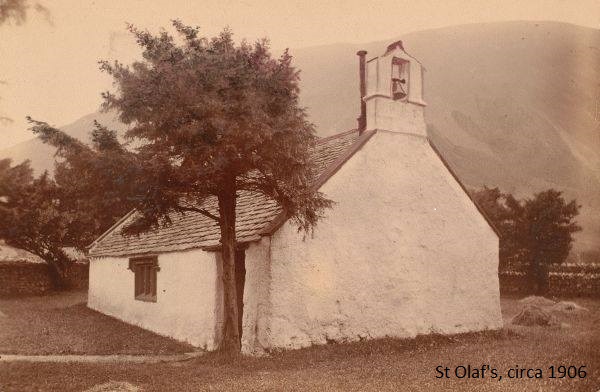
Brief history and description
Wasdale Head was originally a Norse settlement, its first settlers being 2nd and 3rd generation Norse explorers who became farmers after landing on the west coast from Ireland and the Isle of Man around 950 AD. Many place names are of Norse origin (Wasdale – Vatnsdair, valley of the water).
The Norse settlers were Christians and it is likely that there were earlier churches on this site. The earliest record of the present church was in 1550 when the Bishop of Chester ordered the parish to contribute towards the upkeep of St Bees Priory. Mention of it is also made in Eskdale Parish Records in 1587. In 1976 the original vellum parish register was discovered sealed in the small alcove just inside the church door. These records date from 1620 and are now in the county archives in Carlisle. The church is the oldest building in Wasdale and stands at the side of the ancient packhorse trail over Sty Head.
Wasdale Head was originally common land until the Enclosure Act of 1801. The dry stone walls built during the years that followed the Act formed the landscape that we see today, and enclosed an area around the church. The churchyard was consecrated in 1901. Prior to this the dead were carried over the Burnmoor corpse road to be buried at St Catherine’s churchyard in Eskdale. The oldest memorial at St Olaf’s is by the south gate and commemorates three young climbers who fell to their deaths on Scafell Buttress in 1903
The church is simple in form, a single unit under a duo pitched slate roof with a single bell cote at the west end. The walls are local stone with roughcast render and there are just three windows. Detailing to the door and window surrounds is in local St Bees sandstone. The interior is simple with a historic roof structure, whitewashed walls, stone floor and oak pews, basically a little barn, just 142 cubic metres in size.
Legend has it that the church’s ancient roof beams are timbers from Viking ships. Although they have not been carbon dated, it is more likely that they are the original beams of the present building. The remainder of the roof timbers date from 1892, when the roof was renovated. The north pitch has the original Wasdale rough-cut sturdy slates from the old Red Pike quarry, the south pitch later high grade Honister smooth slates. This indicates that at the time the roof was renovated there were not enough of the original ‘sturdies’ in fit condition to cover both pitches.
The church underwent a restrained restoration in 1892. The east window is dedicated to Queen Victoria, the north and south windowsills slope steeply outwards so the rain could run out before the frames and glass were installed. The font is also Victorian, its lowly predecessor stands in the alcove at the back of the church. The door from an earlier oak pew, belonging to the local Stanley family, and dated 1868, forms part of the panelling on the south wall of the tiny chancel. The vestry was partitioned off in 1936 and its ‘roof’ added in 1963. Electricity arrived in 1977 – until the church was lit by oil lamps and there was a coke stove in the alcove. The pipe organ was donated in 1984 replacing an ancient harmonium. Also in 1977 the church became St Olaf’s. Prior to that it was simply Wasdale Head Church!
 St Olaf's Wasdale Head